

A Complete Guide for HR Teams
By Suvarna Singh – CEO & Co-founder, Quinfy Technology Pvt. Ltd.
Hiring does not end when a candidate clears an interview.
A resume can tell an employer where someone says they worked, what they studied, and which qualifications they hold. Background verification checks some of those claims against relevant records, institutions, employers or other permitted sources.
Background verification (BGV) is the process of verifying information provided by a candidate during recruitment or employment. Depending on the position and the employer, this may include identity, address, employment history, education, professional references, criminal or court records and other checks.
The checks are not the same for everyone. A company hiring a software developer may need a different screening package from a bank hiring a finance professional, a logistics company hiring a driver or a healthcare organization hiring a caregiver.
That is the basic idea behind BGV: verify the information that matters for the particular hiring decision.
What Is Background Verification?
Background screening is a process of verification that is used to ensure that relevant information provided by the candidate is accurate and can be verified from appropriate sources.
An employer may want to check previous employment, educational qualifications, identity, residential address, professional references or other information relating to the role.
Take employment history as an example.
A candidate may state that they worked for Company A from 2021 to 2024 as a Senior Executive. During employment verification, the employer or its BGV provider may try to confirm the company, job title and employment period through the relevant verification channel.
Education verification works on the same principle. If a candidate claims a particular degree, the screening process may verify the qualification with the relevant institution or authorized source.
BGV is therefore more than simply searching a person’s name online. It is a structured way of checking information that an employer considers relevant to the hiring decision.
There is also no universal BGV checklist. The scope depends on the employer’s policy, the position, industry, location and the type of information that needs to be verified. Current HR guidance similarly treats identity, employment, education, address and other checks as components that can be selected according to the role rather than as one fixed package.
What Is the Full Form of BGV?
BGV stands for Background Verification.
In HR and recruitment, BGV refers to checking relevant information about a candidate before or during employment.
You may also come across terms such as:
- Employee background verification
- Employee background check
- Employment screening
- Background screening
- Pre-employment screening
- Background check
These terms are often used interchangeably, although individual companies and service providers may give them slightly different meanings.
For practical purposes, the useful question is not whether a company calls the process a “background check” or “BGV.” It is what information is actually being checked.
Why Is Background Verification Important?
A hiring decision is often based on information supplied by the candidate. Verification gives the employer a way to check some of that information before relying on it.
Reduce hiring risk
Verification can help an organization identify information that does not match available records before the person moves into the role.
This does not remove hiring risk completely. It gives the employer more information on which to base its decision.
Identify inaccurate resume information
Candidates sometimes make mistakes on resumes. In other cases, employment dates, job titles or qualifications may be overstated.
A verification process can bring these differences to the employer’s attention.
Verify credentials
Some jobs require a particular degree, license, certification or amount of experience.
Checking those credentials helps the employer determine whether the candidate meets the stated requirement.
Support workplace safety
Certain positions involve access to customers, company premises, vehicles, sensitive information, money or vulnerable people.
Where appropriate and lawful, additional screening can help employers assess information relevant to those responsibilities.
Protect company reputation
A serious hiring mistake can affect customers, colleagues and business partners. Verification gives organizations an opportunity to identify relevant concerns before or during employment.
Support compliance and role-specific requirements
Some industries and positions have additional screening expectations. A structured BGV policy can help HR teams apply the checks consistently instead of deciding the screening scope differently for every candidate.
The point is not to run every possible check on every person. A better approach is to match the screening to the job.
What Is Checked in Background Verification?
The checks included in BGV vary from one organization to another.
Some of the most common are listed below.
1. Identity Verification
Identity verification confirms that the individual being screened corresponds to the identity information provided during recruitment.
Depending on the process, this can involve government-issued identification or other permitted verification methods.
It is an obvious place to start because the results of other checks need to be associated with the correct person.
2. Address Verification
Address verification checks residential information supplied by the candidate.
An employer may need a current address, a previous address or both. The method can vary from digital verification and document checks to physical verification, depending on the service and location.
Address verification is particularly relevant for roles where the employer’s policy requires residential information to be established.
3. Employment Verification
Employment verification checks a candidate’s previous work history.
Depending on the employer’s requirements, this may include:
- Previous employer
- Job title
- Joining date
- Last working date
- Employment status
- Reason for leaving
- Other employment information
Not every previous employer will provide the same level of information. Some organizations may confirm only basic employment details, while others may provide additional information under their verification policy.
4. Education Verification
Education verification checks whether a candidate’s claimed qualification can be confirmed.
The screening may involve:
- University or institution
- Degree or diploma
- Course
- Year of completion
- Certificate details
For jobs where a particular educational qualification is required, this can be a relevant part of the hiring process.
5. Criminal or Court-Record Verification
Criminal or court-record screening is used to look for relevant records through the sources available for the jurisdiction being searched.
This area requires careful interpretation.
A database result should not automatically be treated as proof that a particular record belongs to the candidate. Identity matching, jurisdiction, source quality and the nature of the record all matter.
Employers also need to consider applicable requirements when deciding whether a finding is relevant to a particular job.
6. Reference Verification
Reference verification involves contacting people who can provide information about a candidate’s professional history.
A reference may be asked about the person’s work, responsibilities, professional conduct or association with the organization.
Reference verification is different from employment verification.
Employment verification may establish that a person worked at a company. A reference can provide additional context about that working relationship.
7. Professional License Verification
Some professions require a valid license, registration or certification.
For these positions, the employer may verify:
- License status
- Registration
- Qualification
- Certificate
- Validity period, where relevant
This is particularly relevant when the person cannot perform certain professional duties without the required credential.
8. Credit Verification
Credit or financial checks may be used for selected roles where financial responsibility is relevant and the check is appropriate under applicable requirements.
It should not be assumed that every employee will undergo a credit check.
The relevance of this type of screening depends on the role, employer policy and applicable law.
9. Global Database Checks
Companies hiring internationally may use global databases or other international screening sources to identify information relevant to the candidate and the role.
These checks can involve different countries and data sources, so the availability and reliability of information can vary.
International screening also tends to require more care around jurisdiction-specific requirements and data handling.
10. Social Media Screening
Some employers or screening providers conduct social media screening as part of a broader background screening program.
The purpose should be clearly defined. A professional screening process should not treat every personal post or online opinion as an employment issue.
If social media screening is used, organizations should consider relevance, accuracy, privacy and applicable requirements rather than treating an internet search as a substitute for proper verification.
Quinfy currently lists social media screening among its available background verification services.
11. Drug Screening
Drug screening may be relevant for certain positions or industries, particularly where workplace safety or specific role requirements make it appropriate.
It is not a standard requirement for every employee.
The employer needs to consider the role, local requirements, privacy implications and its own screening policy before including this type of check.
Types of Background Verification
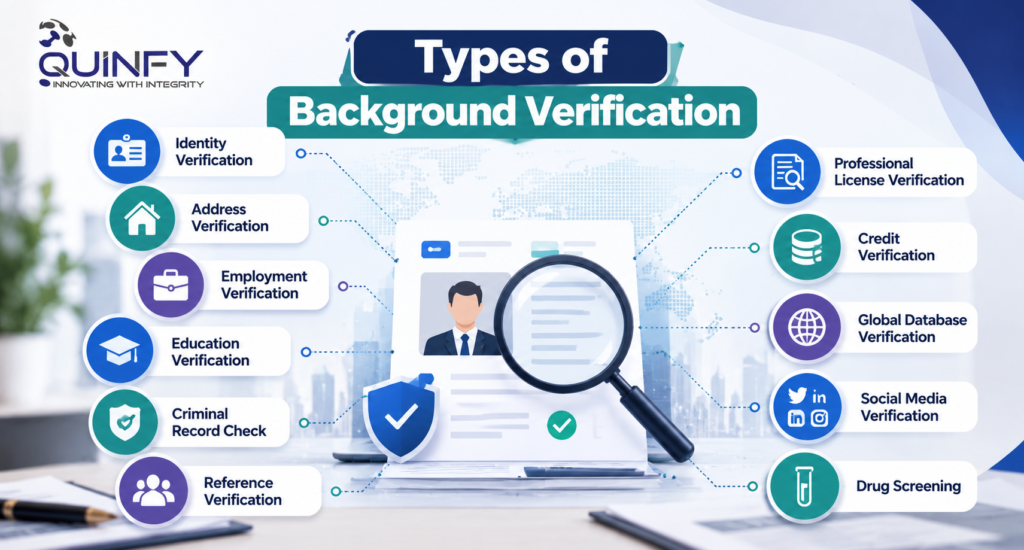
The easiest way to understand the types of BGV is to look at what the employer is trying to establish.
Identity verification
Used to establish that the candidate’s identity information is genuine and belongs to the person being screened.
Address verification
Used to confirm residential information supplied by the candidate.
Employment verification
Used to confirm previous employment and relevant job details.
Education verification
Used to check degrees, diplomas, certificates and other claimed qualifications.
Criminal verification
Used to search relevant criminal or court records through appropriate sources.
Reference verification
Used to gather professional information from references supplied by the candidate.
Professional license verification
Used where a role requires a license, registration or professional credential.
Credit or financial checks
Used for selected positions where financial responsibility makes such screening relevant.
Global database checks
Used where international screening or particular database searches form part of the employer’s policy.
Social media screening
Used by some organizations to review publicly available online information as part of a wider screening process.
Drug screening
Used for selected roles where such testing is relevant and permitted.
These categories should not be confused with a universal BGV package. A company can select some checks and leave others out.
For example, a driver may require driving-related verification that would make little sense for a desk-based employee. A finance role may involve financial screening that would not be relevant to a warehouse position.
How Does the Background Verification Process Work?
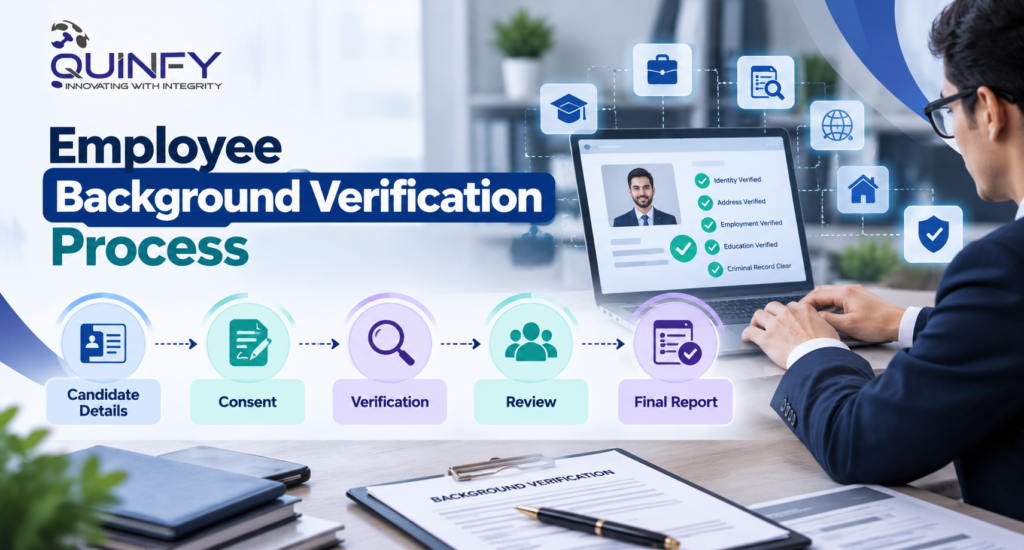
There is no single workflow followed by every BGV provider, but a typical employment screening process can be broken into ten stages.
1. Define the verification requirements
The employer decides what needs to be checked.
The decision should reflect the role, industry, risk exposure, company policy and applicable requirements.
2. Collect candidate information
The candidate provides the information required for the selected checks.
This may include employment history, education, addresses, identity information and references.
3. Obtain the required consent or authorization
Before screening begins, the candidate should receive appropriate information about the process and provide the required authorization or consent where applicable.
4. Collect supporting documents
The candidate submits documents needed for the selected checks.
Incomplete information at this stage can lead to follow-ups later.
5. Verify identity
Identity information is checked using the verification methods selected by the employer or BGV provider.
6. Verify employment and education
Previous employers and educational credentials are checked where those verifications form part of the package.
7. Run other selected checks
Address, criminal/court, reference, license, financial or other checks can be conducted depending on the screening scope.
Some checks can run at the same time rather than one after another.
8. Review discrepancies
If information does not match, the issue is recorded and reviewed.
This is an important stage. A difference in an employment date does not carry the same meaning as a fabricated qualification.
9. Prepare the verification report
Completed checks and findings are brought together in a report or digital dashboard.
10. Employer reviews the findings
The employer decides what action is appropriate based on its policy, the role and the nature of the findings.
Current BGV guidance also emphasizes that a practical process should balance screening scope, candidate experience, privacy and hiring timelines rather than treating verification as a single mechanical checklist.
What Documents Are Required for Background Verification?
There is no universal BGV document list.
The documents requested depend on the checks being conducted and the employer’s policy.
A candidate may be asked for:
- Government-issued identity document
- Address proof or address details
- Degree or diploma certificate
- Marksheets
- Previous employer details
- Experience or employment documents
- Professional certificates
- License or registration details
- Reference information
- Other documents relevant to the position
A software engineer, delivery executive, finance manager and healthcare worker may therefore receive very different document requests.
One recent BGV industry guide similarly notes that document requirements vary according to the checks, role, employment history and organizational policy.
A simple candidate checklist
Before the process begins, it helps to have:
- Accurate employment dates
- Previous employer names and contact details
- Education details
- Relevant certificates
- Current and previous addresses
- Reference contact information
- Valid identity documents
Most delays caused by candidates are easier to avoid when this information is collected before the verification request is sent.
When Is Background Verification Done?
BGV can happen at several points during hiring.
Before an offer
Some employers start screening before making a final employment decision.
After a conditional offer
Another common approach is to make an offer subject to successful verification.
Before joining
The employer may want the selected checks completed before the candidate’s first day.
During onboarding
Some checks may continue while other onboarding activities are already underway.
After joining
An organization may complete pending checks after the employee starts.
Periodic re-verification
Certain organizations or roles may require additional screening after employment has already begun.
There is no single timing rule that applies to every company.
The important thing for candidates is to read the employment offer and BGV communication carefully. If an offer is conditional on verification, the terms should explain the relevant condition.
How Long Does Background Verification Take?
The honest answer is: it depends on what needs to be verified.
A simple digital identity check may move quickly. Employment verification can take longer if a previous employer is slow to respond. Education verification can also depend on the institution and the records available.
The timeline can be affected by:
- Number of checks
- Number of previous employers
- Educational institutions involved
- Candidate documentation
- Location
- Availability of records
- Response time from third parties
- International checks
- Manual field verification
- Discrepancies requiring clarification
A candidate with one recent employer and complete documentation may have a very different experience from someone with five employers across three countries.
For that reason, a BGV provider’s stated turnaround time should be understood as an expected service timeline for its particular workflow, not as a universal industry standard.
What Happens If Background Verification Fails?
A BGV result that contains a discrepancy is not necessarily the same thing as a failed hiring decision.
There are several possibilities.
Minor discrepancy
An employment date may be slightly different from the date written on the resume.
The employer may simply ask the candidate to explain the difference.
Missing information
A candidate may have forgotten to mention an old employer or may not have supplied a required document.
The verification team may request the missing information.
Name mismatch
A person’s name may appear differently across documents.
This can require additional documentation or identity confirmation.
Employment gap
A candidate may have a period between two jobs that was not clearly explained.
An employment gap itself is not proof of misconduct.
Major qualification discrepancy
A claimed degree or certification may not be verifiable.
That can be more serious when the qualification is a requirement of the job.
False documentation
Submitting an altered or fabricated document is a more serious issue than a simple date mismatch.
Adverse finding
A screening process may identify a record that the employer considers relevant. The employer then needs to assess the information in accordance with its policy and applicable requirements.
The most useful distinction is this:
A discrepancy is a reason to investigate. It is not automatically proof of fraud.
The employer may ask questions, review supporting evidence and then decide what to do.
Background Verification for Employees vs Other Use Cases
Background verification is not limited to permanent employees.
The checks change depending on the relationship between the person and the organization.
Employees
Employee BGV commonly focuses on identity, employment history, education, address and references.
Additional checks can be added where the role calls for them.
For a senior finance position, for example, the screening scope may be broader than it would be for a general administrative role.
Contractors
Contractors may not be direct employees, but they can still have access to company offices, customers, equipment, confidential information or operational systems.
That makes verification relevant for certain contractor roles.
The exact checks depend on the contract, assignment and level of access.
Gig Workers
Delivery partners, drivers, home-service workers and other gig workers often interact directly with customers.
For these workers, identity, address, driving credentials or other role-specific checks may be relevant.
Quinfy currently offers a separate background verification workflow for gig workers, including digital onboarding and verification APIs.
Drivers
Driver screening can involve identity, address, driving credentials, criminal checks and driving records, depending on the employer and applicable requirements.
This is particularly relevant for logistics, fleet, cab and delivery businesses.
Quinfy lists identity, driving-license, criminal, address and driving-record checks among the services available for driver verification.
Healthcare Workers
Healthcare roles can involve access to patients, medical information and sensitive environments.
Depending on the position, employers may verify education, professional qualifications, references, identity, address and other relevant information.
The screening should reflect the actual responsibilities of the worker rather than applying an unnecessarily broad package.
Tenants
Tenant screening is different from employee BGV because the decision is about a rental relationship rather than employment.
Depending on the screening policy, verification may include identity, address, rental history, references and financial information.
Quinfy also offers a separate tenant verification service covering checks such as identity, criminal, address and financial screening.
Domestic Help
Domestic workers may have access to a private home, family members and personal belongings.
Depending on the situation, screening can involve identity, address, references and relevant police or criminal checks.
Quinfy currently provides a dedicated house-help verification service covering identity, address, references and criminal verification.
The lesson across all these use cases is the same: screening should be designed around the person’s role and the risks associated with it.
Background Verification in India
Background verification in India is commonly used across IT, BFSI, healthcare, logistics, retail, manufacturing, real estate and other sectors.
The exact process differs between employers.
A typical employment screening program may include:
- Identity verification
- Address verification
- Employment verification
- Education verification
- Reference checks
- Criminal or court-record checks
- Professional credential verification
- Additional checks for specific roles
For example, a company hiring a software professional may focus heavily on employment and education history. A logistics company may place more emphasis on identity, address and driver-related checks. A healthcare organization may need to establish professional qualifications and registrations.
There is no sensible reason to give all three candidates the exact same BGV package.
What about Aadhaar and PAN?
Aadhaar, PAN and other identity documents may form part of specific verification workflows in India. However, the fact that a document exists does not mean it is appropriate to use it for every screening purpose.
The document, verification method and data use should be appropriate to the stated purpose and applicable requirements.
What about police verification?
Police or criminal verification can be relevant to some roles and use cases, but it should not be described as a universal requirement for all employees.
The process and availability of records can also vary by location.
What about data protection?
This has become an increasingly important part of BGV in India.
The Digital Personal Data Protection Act, 2023 provides India’s statutory framework for processing digital personal data, and the Ministry of Electronics and Information Technology lists the Digital Personal Data Protection Rules, 2025, notified on November 14, 2025.
The practical implication for HR teams is straightforward: collecting more personal information simply because it is available is not a good BGV strategy. Organizations should consider what information they need, why they need it, how it is handled and who can access it.
Background Verification and Data Privacy
BGV involves personal information. That makes privacy part of the process, not an afterthought.
A responsible verification workflow should consider:
Tell candidates what is being checked
Candidates should receive appropriate information about the verification process.
Collect information for a defined purpose
If an employer only needs to confirm employment history, it should have a reason before collecting unrelated personal information.
Obtain the required consent or authorization
Where consent or authorization is the applicable basis or requirement, it should be handled properly before the relevant check begins.
Protect the information
BGV reports can contain identity details, addresses, employment history, education records and potentially sensitive information. Access should therefore be controlled.
Limit unnecessary access
Not everyone in an organization needs to see a complete background report.
Think about retention
Organizations should have a clear approach to how long verification information needs to be retained and what happens when it is no longer required.
Give discrepancies a proper review
Automated flags should not become automatic employment decisions without appropriate human consideration.
For Indian organizations, the DPDP framework is now part of the privacy landscape. MeitY’s published material states that the 2025 Rules establish the framework for safeguarding personal data and implementing the DPDP Act.
Because the legal position can depend on the exact data, purpose, parties involved and processing activity, this article should not be treated as legal advice.
Background Verification vs Background Check
The terms background verification and background check are often used interchangeably.
There is a difference in emphasis, but not always a strict industry boundary.
Background Verification: Often focuses on validating information supplied by a candidate Broader phrase for checking a person’s background. Common in recruitment Used in employment and other screening situations Can include education, employment, identity and address verification Can include verification plus additional screening. Usually involves checking specific claims or records Scope depends on the purpose and provider
For example, an HR team may use “background verification” when referring to employment and education checks. Another company may call the same process a “background check.”
Neither label tells the complete story.
When evaluating a BGV provider, the better questions are:
- What checks are included?
- What sources are used?
- How are discrepancies handled?
- How is candidate consent managed?
- How are reports delivered?
- What technology is used?
- How is personal information protected?
How Technology Is Changing Background Verification
The old BGV workflow could involve emails, spreadsheets, scanned documents, phone calls and repeated follow-ups.
That becomes difficult when an organization is hiring hundreds or thousands of people.
Technology has changed the way many BGV teams manage the process.
AI-assisted verification
AI can be used to assist with document processing, data extraction, matching and workflow tasks.
The useful role for AI is often behind the scenes. It can help a team handle large volumes of information, but a flagged result may still require human review.
APIs
APIs allow verification systems to communicate with HRMS, ATS and other business applications.
Instead of moving information manually between systems, an organization can connect the BGV workflow to the tools it already uses.
Automation
Automation can handle repetitive tasks such as:
- Sending verification requests
- Collecting candidate information
- Updating case status
- Triggering reminders
- Organizing documents
- Generating reports
This reduces some of the administrative work associated with high-volume hiring.
Digital verification
Digital workflows can reduce dependence on paper documents and manual coordination.
Candidates can submit information online, verification requests can be initiated digitally, and HR teams can follow progress without maintaining separate spreadsheets.
Real-time dashboards
A dashboard gives HR teams a central view of their verification cases.
They can see which cases are:
- Newly initiated
- In progress
- Waiting for information
- Completed
- Flagged for review
This is particularly useful when an organization has multiple hiring teams or locations.
Blockchain
Blockchain has also been explored in credential and verification systems.
Its potential value is in creating records that can be independently validated and made harder to alter after creation. But blockchain is not a required component of BGV, and organizations should not choose a verification platform simply because it uses the term.
The underlying verification method matters more than the technology label.
Quinfy’s current website describes QuinBlock as a private blockchain product and also lists QuinAI and QuinPlus among its technology offerings. Its BGV materials describe API/HRMS automation, dashboards and digital verification workflows.
The broader shift is fairly simple: BGV is moving from a collection of manual tasks toward a connected workflow in which candidates, verification teams and HR departments can see what is happening at each stage.
Why Choose Quinfy for Background Verification?
Once an organization moves beyond occasional screening, managing BGV manually can become difficult.
There are candidate documents to collect, multiple checks to coordinate, verification responses to track and reports that need to reach the right people.
Quinfy provides background verification services covering identity, address, employment, education, criminal, professional reference, social media and other checks. Its employment verification offering also allows organizations to select additional checks based on their requirements.
Quinfy’s employment background verification service includes identity, highest education, last employment, criminal record and professional reference verification, with additional checks available according to business requirements.
The technology side is designed around the same problem. Quinfy describes integration between HRMS/ATS systems and its SaaS platform, while its broader platform materials describe real-time status and report visibility.
That can be useful for organizations dealing with regular hiring volumes, multiple verification types or distributed recruitment teams.
The right screening package still depends on the job. Quinfy’s own service pages describe customizable checks rather than suggesting that every candidate needs the same set of verifications.
Frequently Asked Questions About Background Verification
1. What is background verification?
Background verification is the process of checking relevant information provided by a candidate against appropriate records or sources. It can include employment, education, identity, address, reference and other checks depending on the job.
2. What is the full form of BGV?
BGV stands for Background Verification. In HR, it refers to the process of verifying relevant candidate information during recruitment or employment.
3. Why is background verification important?
Companies use BGV to verify candidate information, identify discrepancies, reduce hiring risk and check credentials relevant to a position. Some roles may also require additional screening for safety, regulatory or business reasons.
4. What is checked during BGV?
Common checks include identity, address, employment, education, criminal or court records, professional references and licenses. Credit, social media, drug and global database checks may be added when appropriate.
5. How does the background verification process work?
The process generally involves defining the checks, collecting candidate information, obtaining the required authorization or consent, gathering documents, conducting verification, reviewing discrepancies, preparing a report and allowing the employer to review the findings.
6. What documents are required for background verification?
The requirements depend on the checks. Candidates may be asked for identity documents, address information, education certificates, employment details, professional credentials and reference information.
7. How long does background verification take?
There is no universal BGV timeline. The duration depends on the number and type of checks, candidate documentation, previous employers, educational institutions, locations and response times.
8. When is background verification done?
BGV may happen during recruitment, after an offer, before joining, during onboarding or after joining. The timing is determined by the employer’s policy and the role.
9. What happens if background verification fails?
The employer may review the discrepancy, ask the candidate for clarification or request additional documents. A discrepancy does not automatically mean that the candidate committed fraud.
10. Is BGV mandatory for every job?
No. There is no single BGV requirement or package that applies to every job. Screening depends on the employer, position, industry, location and applicable requirements.
11. Can BGV verify previous employment?
Yes. Employment verification can confirm information such as previous employer, job title and employment period, depending on the source and verification process.
12. What is the difference between BGV and a background check?
The terms are often used interchangeably. BGV commonly refers to validating information provided by a candidate, while “background check” is a broader term that can include several types of screening.