
Short answer:
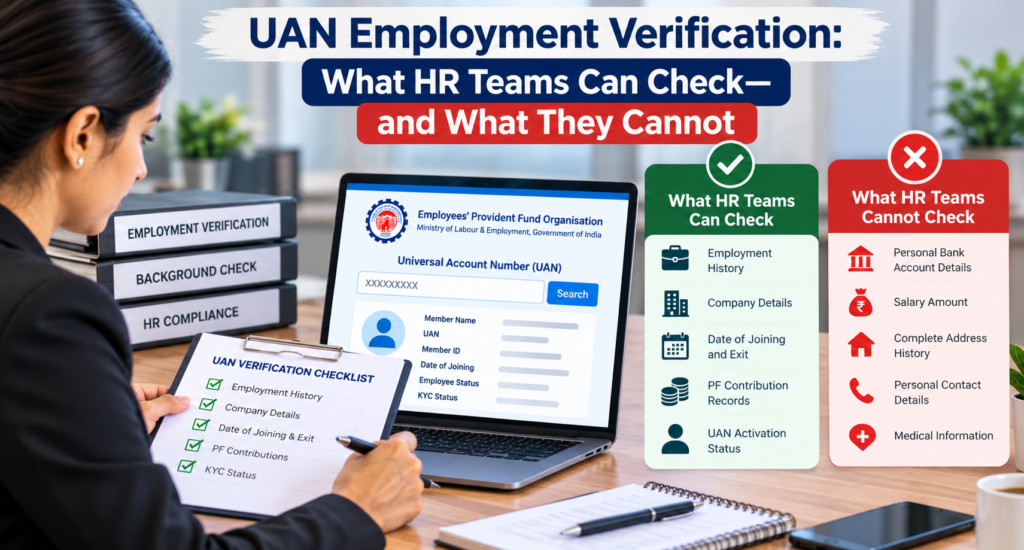
UAN employment verification uses available EPFO-linked records to cross-check a candidate’s employment information. It can support checks of recorded employers, contribution activity, and some employment dates. It is not a complete work-history report and does not, by itself, confirm designation, salary, responsibilities, or performance.
For many HR teams in India, employment verification starts with a familiar problem: the candidate’s resume says one thing, while the documents received from a previous employer say something slightly different. Sometimes the difference is harmless. Occasionally it needs a closer look.
A UAN-related check can give the employer another point of comparison. It may support the information provided by the candidate or draw attention to a period that needs clarification. But it should be treated as evidence—not as the final answer to every employment question.
What is UAN employment verification?
UAN stands for Universal Account Number. It is connected with an EPFO member’s provident fund services. EPFO provides services such as UAN activation, passbook access, KYC updates, and online claims through its official platforms.
During employment screening, HR teams may review available EPFO-linked information through an authorised process. Depending on the records and access available, the information may help establish that an employer relationship or contribution activity was recorded.
The important word is available. A UAN does not automatically reveal a person’s entire working life. It may not show work outside the relevant EPFO records, overseas employment, or an arrangement that was never recorded in the expected way. It also does not tell an employer whether someone was good at their job.
How does UAN employment verification work?
The process is usually part of a wider employee background check.
1. Explain the check to the candidate
Tell the candidate why the information is needed, what will be reviewed, and how the result will be used. Obtain the appropriate consent or authorisation for the verification route being followed.
A UAN should never be used as an excuse to request a candidate’s EPFO password or one-time password. Account credentials should remain private.
2. Use an authorised verification route
The information available will depend on the service used, the status of the candidate’s account, the records connected to it, and the permissions in place. Simply knowing someone’s UAN does not give unrestricted access to private account information.
3. Review the available records
The reviewer may look at recorded employer associations, contribution entries, and relevant employment-related dates. These details show what is present in the record. They do not automatically explain the person’s role, salary, reporting line, or reason for leaving.
4. Compare the result with documents
Compare the information with the candidate’s resume, application form, experience letter, relieving letter, salary documents, and declaration. Pay attention to material differences, but do not assume that every difference means dishonesty.
5. Give the candidate a chance to explain
If something does not match, ask questions before reaching a conclusion. A difference may come from a payroll cut-off, a group-company transfer, a staffing arrangement, an administrative error, or a delayed record update. If the issue remains important, contact the previous employer or request additional evidence.
| Stage | What HR is trying to do |
| Scope and authorisation | Decide what is being checked and obtain permission |
| Record review | Examine available EPFO-linked information |
| Document comparison | Compare records with the candidate’s claims |
| Clarification | Understand and investigate differences |
| Final assessment | Record the evidence and make a fair decision |
What can UAN verification show?
UAN verification may help HR teams review the following information when it is present in the available records:
| Information | What it may indicate |
| Employer or establishment details | A recorded association with that establishment |
| Contribution activity | Provident fund contributions recorded during a period |
| Employment-related dates | Supporting evidence for dates shown in the record |
| Differences from the resume | A matter that may require clarification |
| Job title and responsibilities | Usually require employer or document confirmation |
| Salary | Usually requires salary documents or employer confirmation |
| Complete work history | Cannot be guaranteed from UAN records alone |
An apparent overlap between contribution periods may deserve attention, but it is not automatically proof of dual employment or misconduct. The employer should understand the circumstances before making a decision.
Why do employers use UAN-based verification?
Used carefully, a UAN check can be useful because it adds another source of employment-related evidence. It may help an HR team identify a date discrepancy early, compare a candidate’s declaration with an available record, or decide whether a direct employer check is needed.
It is particularly useful as part of a structured screening process. It is less useful when treated as a shortcut for every other employment check.
What are the limitations?
The record may be incomplete
A missing record does not automatically prove that the candidate never worked for an organisation. Records may be unavailable, outdated, incomplete, or affected by reporting practices.
Not every job will appear in the same way
Employment coverage and record availability can depend on the nature of the work, employer reporting, eligibility, and individual circumstances. Overseas employment and work outside the relevant EPFO-covered arrangements may not appear.
It does not confirm the whole job
UAN-related information should not be presented as proof of designation, responsibilities, performance, salary, reporting manager, or reason for leaving. Those details normally require a document check, a previous-employer response, or both.
Dates can differ for innocent reasons
A joining date or last-working date may vary between payroll records, HR records, and a relieving letter. Notice periods, transfers, and data-entry errors can all create differences. The candidate should have an opportunity to explain them.
Privacy still matters
UAN-linked information is personal information. HR teams should limit the check to a genuine business purpose, use authorised access methods, restrict internal access, protect reports, and follow their privacy and retention policies. EPFO’s official portal provides secure member services, including UAN activation and passbook access.
| Issue | Sensible HR response |
| Missing record | Request supporting documents |
| Date difference | Compare sources and ask for clarification |
| Unconfirmed designation | Contact the previous employer |
| Incomplete history | Add relevant employment checks |
| Restricted access | Use an authorised process |
UAN verification vs direct employment verification
These are not identical checks.
| UAN-based check | Direct employment check |
| Uses available EPFO-related records | Uses the previous employer and supporting evidence |
| May support employer and contribution review | Can confirm job title, dates, salary, and other details when the employer responds |
| Dependent on record availability and access | Dependent on employer response and documents |
| Best used as supporting evidence | Best used when a specific employment detail must be confirmed |
For a senior, regulated, or client-facing role, relying on only one source may leave important questions unanswered. A sensible process combines the sources that are relevant to the job.
Practical guidance for HR teams
Before starting a UAN-related check, HR teams should:
•explain the purpose and scope of the verification;
•obtain appropriate authorisation;
•avoid collecting passwords and OTPs;
•compare records with the candidate’s documents;
•investigate discrepancies rather than labelling them immediately as fraud;
•contact former employers when the role requires confirmation of title, salary, or responsibilities; and
•keep a clear record of the sources reviewed and the final reasoning.
Frequently asked questions
Can employers verify previous employment using a UAN?
They may use available UAN-related information as one source of evidence when the process is authorised. It should be compared with documents and direct employer confirmation where necessary.
Does UAN verification show a complete employment history?
No. Record gaps, reporting issues, non-covered work, overseas employment, and access limitations can affect the result.
Can UAN verification confirm designation and salary?
Not by itself. Job title, responsibilities, salary, and reason for leaving usually require employer confirmation or supporting documents.
Is UAN verification enough for a background check?
No. It is one part of a background check. Depending on the role, HR may also need identity, education, address, criminal-record, reference, or licence checks.
What should HR do if the records do not match?
Ask the candidate for an explanation and supporting evidence. If the difference remains significant, contact the previous employer or conduct another relevant check.
Is candidate consent needed?
HR teams should use the appropriate consent or authorisation process for the verification route and explain what will be checked. Account passwords and OTPs should never be requested.
Conclusion
UAN employment verification can give HR teams a useful additional reference point. It may support employer, contribution, and date checks, but it cannot replace direct employment verification or prove a complete work history. The fairest approach is to compare the available record with documents, investigate differences carefully, and use previous-employer confirmation when the role requires more detail.